
This blogpost is written by François Abuka Balabala Alumesa, David Kopa wa Kopa & Birgit Ricquier. Please cite as:
Abuka Balabala Alumesa, François, David Kopa wa Kopa & Birgit Ricquier. 2026. Mokpa (D15). Blogpost on BANTURIVERS website: https://banturivers.eu/en/mokpa-d15/ .
At the start of the BANTURIVERS project, the linguists of the University of Kisangani suggested that we would work on a language called “Kileka”, spoken some 60 kms south of Kisangani. The very first fieldwork trip of the project was a visit to a “Leka” village at the border of the Lualaba River. We soon learned that the autochthonous name of the language is Mokpa, or Cenamokpa, informing us right away about the presence of labial-velars which became a first research topic. David Kopa wa Kopa continued the study of the language’s history in the context of his PhD. What follows is a presentation of this hitherto poorly known language. The Mokpa language ID can be found on our language map.
Geography
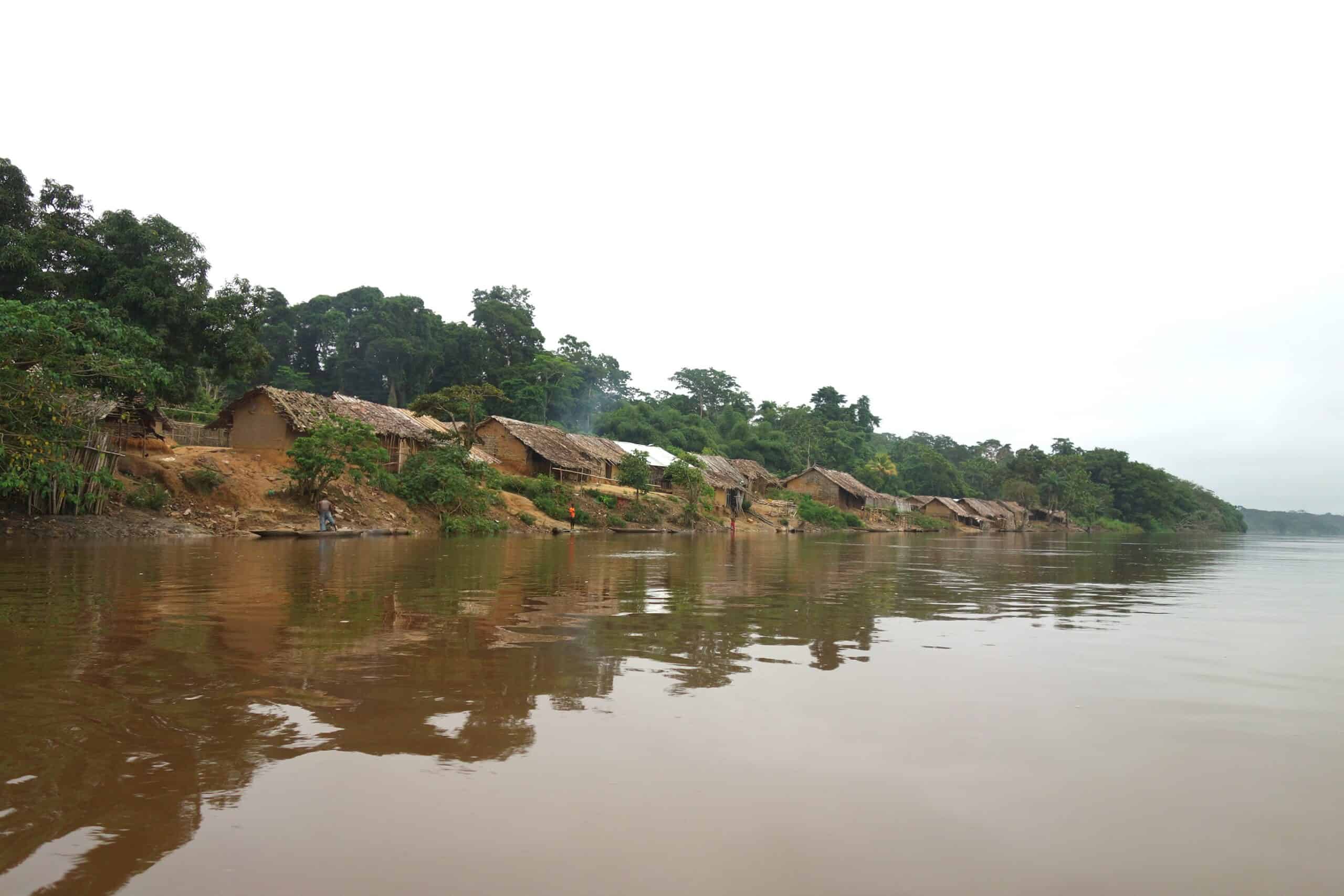
Mokpa, or Cenamokpa, is a Bantu language spoken in 15 villages at the riverbanks of the Lualaba, from Batikalela to Tubundubundu (2 kilometers from Ubundu). The location at the riverbank corresponds to the self-identification of the Mokpa as fishermen communities, in contrast to the neighboring Komo who live inland, east of the Lualaba. Other neighboring communities include the Enya (or Wagenya) and Lengola. The Enya, also fishermen, live at the Boyoma aka “Wagenya” Falls, Kisangani. The Lengola live primarily on the left bank of the Lualaba, but south of the Mokpa area, Lengola villages are also found on the right bank of the river. This region south of Kisangani uses Kiswahili as a vehicular language. Research by David Kopa wa Kopa demonstrates that the common use of Kiswahili threatens the intergenerational transmission of Mokpa (Kopa wa Kopa 2025).
The term “Mokpa” is not found in the colonial archives, nor in ethnographic literature. Only the exonym “Baleka,” meaning the “Leka people,” is cited, but the term may also refer to “river people” in general, as it has also been applied to Metoko and Lengola communities (see Ricquier et al. 2023). “Leka” is also found in a sculpture handbook and ethnographic map by Felix (1987:72; 2005) but refers mostly to the Enya as well as the Mbole and Metoko along the Congo and Lualaba Rivers. The absence of recognition of the Mokpa community by colonial officials has administrative consequences, namely that the villages currently belong to different “secteurs” of the Ubundu Territory, namely Bakumu Mandombe, Bakumu d’Obiatuku and Walengola-Baleka.
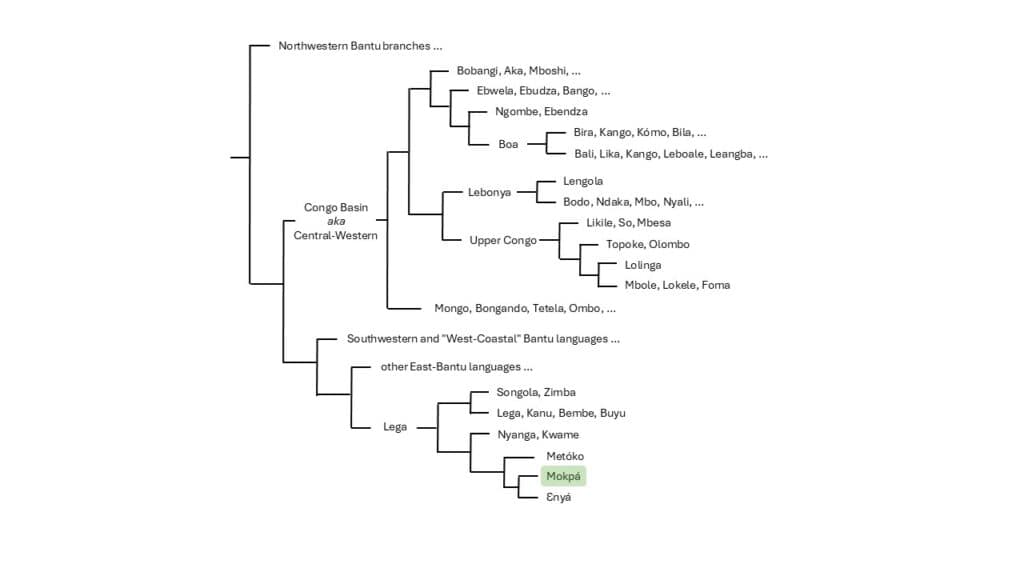
Phylogenetic research by Ricquier, Grollemund and colleagues (2022; article in preparation) has demonstrated that Mokpa belongs to the Lega subgroup and is most closely affiliated to Enya (D14) and Metoko (D13); the neighboring languages Lengola (D12) and Komo (D23) are not closely related and in fact belong to a different Bantu subgroup (see figure 2). Therefore, we propose Bantu code D15 for Mokpa.[1] As for the code in the Atlas Linguistique de la République Démocratique du Congo (AL-RDC) (Maalu Bungi 2010), we propose the vacant number 435, as to be situated near the related languages mentioned here.[2] Mokpa does not show significant dialectal variation.
Overview of the literature
Until recently, Mokpa was hardly known by the scientific community. It has not even received a spot in Ethnologue (Eberhard et al. 2026). Only one published work has been found for Mokpa, a grammar sketch (Motingea Mangulu 1990). Two dissertations have been written on the language but are not easily accessible (Salumu 1990; Satugombo 2008).[3] François Abuka also worked previously on the language, from a comparative perspective (Abuka 1998; 2021).
Some linguistic features
Even though Mokpa is genetically close to Enya, it is considered a distinct language by its speakers. Many lexical differences can be cited, even in basic vocabulary, as is demonstrated in Table 1.
| English | Mokpa | Enya | Metoko |
| ‘feather’ | osá | itɔngɔ́ | keóɸe |
| ‘heart’ | cetóo | motéma | motéma |
| ‘knife’ | ɔwɛ́ɔ | kaɓúsú | kaɔmbá |
| ‘night’ | cendi | ɓotú | moísí |
| ‘person’ | mɛa | moto | monto |
| ‘sky’ | iyo | oɓóa | mbingóni |
| ‘to bite’ | kogbúya | kofunya | kɔtɔ́a |
| ‘to give’ | końka | koésa | koɸá |
| ‘to see’ | kɔsɛ́a | kɔmɔ́na | kɔmɔ́a |
| ‘to sleep’ | koɓonga | koláma | kolá |
Table 1: Non-exhaustive lexical differences between Mokpa, Enya and Metoko
Phonologically, Mokpa has a two-tone distinction, seven vowels [i e ɛ a ɔ o u], voiced and voiceless labial-velar plosives [g͡b] and [k͡p], and two implosives [ɓ] and [ɗ]. The labial-velar plosives have been the topic of a comparative study (Kopa wa Kopa & Ricquier 2023). Mokpa noun class prefixes use [w] rather than [ɓ] as found in Metoko and Enya, leading to a clearly different pronunciation of the prefixes of noun class 2, 8 and 14 (see table 2). More examples of this sound correspondence can be cited, for instance Mokpa mowe versus Enya and Metoko moɓe ‘body’, but it does not seem to have systematically affected the lexicon.
| Mokpá | Enya | Metoko | |||||||||
| Class | Form | Class | Form | Class | Form | Class | Form | Class | Form | Class | Form |
| 1 | mo- | 2 | wa- | 1 | mo- | 2 | ɓa- | 1 | mo- | 2 | ɓa- |
| 3 | mo- | 4 | me- | 3 | mo- | 4 | me- | 3 | mo- | 4 | me- |
| 5 | i-, li- | 6 | ma- | 5 | i-, li- | 6 | ma- | 5 | i-, li- | 6 | ma- |
| 7 | ce- | 8 | we- | 7 | ce- | 8 | ɓe- | 7 | ke- | 8 | ɓe- |
| 9 | N- | 10 | N- | 9 | N- | 10 | N- | 9 | N- | 10 | N- |
| 11 | o- | 10 | n- | 11 | o- | 10 | N- | 11 | o- | 10 | N- |
| 12 | ka- | 13 | to- | 12 | ka- | 13 | to- | 12 | ka- | 13 | to- |
| 14 | wo- | 6 | ma- | 14 | ɓo- | 6 | ma- | 14 | ɓo- | 6 | ma- |
| 15 | ko- | 15 | ko- | 15 | ko- | ||||||
Table 2: Noun class prefixes and pairings: observe that in the three languages, class 9 and 12 can also be paired with 6, in Metoko this is also the case for singulars in class 11
Mokpa has all of the first 15 Bantu noun classes (see Table 2). Like the closely affiliated Enya and Metoko but unlike other Bantu languages in the vicinity, Mokpa makes frequent use of noun classes 12 ka- (singular) and 13 to- (plural), beyond forming diminutives. Noun class 12 may also take noun class 6 ma- as a plural, but this is less common (see Table 3).
| singular | plural | ||
| 12/13 | ‘bird’ | kayoni | toyoni |
| 12/13 | ‘mouth’ | kama | toma |
| 12/6 | ‘foot’ | kao | mao |
Table 3: Noun class 12 in Mokpa
Mokpa in the BANTURIVERS project
Mokpa was the focus language of David Kopa wa Kopa’s PhD dissertation, successfully defended in March 2025 (link to other blogpost). The dissertation studies past and present language contact between Mokpa and its neighbors Enya, Metoko, Lengola, Komo and Mbole. Results concerning the presence of labial-velars have been published in Kopa wa Kopa & Ricquier (2023) and Ricquier et al. (2023). Further research concerns the current sociolinguistic and language contact situation, and more lexical and phonological comparison (Kopa wa Kopa 2025; Kopa wa Kopa & Ricquier 2025). The dissertation concludes that the ancestors of Mokpa and its closest kin, Enya and Metoko, were in contact with the ancestors of Mbole speakers. Evidence can be found in phonology, specifically the labial-velars, and the lexicon. Mokpa also exchanged vocabulary with languages such as Lengola and Komo. As for the current sociolinguistic situation, Mokpa is rarely transferred to the youngest generation, Swahili is used instead; this suggests that Mokpa is on the verge of extinction.
References
Abuka Balabala Alumesa, Francois. 1998. Etude lexicostatistique de trois langues du groupe D10 y compris des éléments du Proto-Bantu. Les Cahiers du CRIDE, Nouvelle série 1:79-100.
Abuka Balabala Alumesa, Francois. 2021. Langues riveraines de Kisangani à Ubundu. Étude descriptive, comparative et classificatoire (3 langues : enya, lengola et mokpa). Université de Kisangani: these de doctorat.
Eberhard, David M., Gary F. Simons, and Alison J. Robinson (eds.). 2026. Ethnologue: Languages of the World. Twenty-ninth edition. Dallas, Texas: SIL Global. Online version: https://www.ethnologue.com/ .
Felix, Marc Leo. 1987. 100 peoples of Zaire and their sculpture. The handbook. Brussels, San Francisco & Bukavu: Zaïre Basin Art History Research Foundation.
Kopa wa Kopa, David. 2025. Phénomènes de contact linguistique dans le nord-est du bassin du Congo : Cas de langues mokpá, ɛnyá, metóko et les autres langues du bas Lualaba. Université libre de Bruxelles : thèse de doctorat.
Kopa wa Kopa, David and Birgit Ricquier. 2023. Les labiales-vélaires et l’histoire linguistique de trois langues bantu orientales : ɛnyá, mokpá et metóko. Linguistique et langues africaines 9(2). https://doi.org/10.4000/lla.13070 .
Kopa wa Kopa, David & Birgit Ricquier. 2025. De la stratigraphie lexicale dans trois langues lega à l’histoire de contact linguistique dans le cours inférieur de la Lualaba (RDC). Africana Linguistica 31:69-106. DOI: 10.2143/AL.31.0.3295059 .
Maalu Bungi, C. 2010. Atlas Linguistique de la République Démocratique du Congo (AL-RDC). Yaoundé: CERDOTOLA.
Maho, Jouni Filip. 2009. NUGL Online. The online version of the New Updated Guthrie List, a referential classification of the Bantu languages. https://www.yumpu.com/en/document/view/15754239/nugl-online-glocalnet .
Motingea Mangulu, Andrea. 1990. Esquisse de la langue des Mokpá. Afrika und Ubersee 79:66-100.
Ricquier, Birgit, Rebecca Grollemund, David Kopa wa Kopa, Constance Kutsch Lojenga, François Abuka Balabala Alumesa, Nicolas Mombaya Liwila & Emmanuel Ngbanga Bandombele. 2022. A new phylogenetic classification for the Bantu languages of the northeastern Democratic Republic of the Congo. Paper presented at the International Conference on Historical Linguistics 25, Oxford University, 1-5 August 2022.
Ricquier, B., Nieblas Ramirez, L., Livingstone Smith, A., Takamura, Sh., Kopa wa Kopa, D., & Daou Joiris, V. 2023. Paths in the eastern Congo rainforest: Vernacular histories, colonial interpretations and linguistic data on the settlement of the lower Lualaba. Afriques 14 (en ligne). DOI: https://doi.org/10.4000/afriques.4465 .
Salumu, R. 1990. Identité linguistique d’Inamokpá de la zone d’Ubundu (Haut-Zaire). Département de Francais, Insitut Supérieur Pédagogique de Mbandaka.
Satugombo, S. G. 2008. Etude lexico-sémantique de la langue leka. Département de Francais-Langues Africaines, Institut Supérieur Pédagogique de Kisangani.
[1] In a previous publication (Kopa wa Kopa & Ricquier 2023), we proposed the code D142, as D141 had been proposed for Zula (Maho 2009). However, considering that Zula is not genetically closely affiliated and that Mokpa should not be considered a dialect of Enya, we think that “D15” is more appropriate and should be used henceforth.
[2] More precisely: enya 406, komo 412, lengola 416, metoko 421.
[3] We have not been able to consult these works.